
By Mike Hilbun
“Midnight Voyage” is the second track from Michael Brecker’s 1996 album Tales from the Hudson. The album, which featured the great Pat Metheny on guitar, earned Brecker two Grammy awards. Today we’ll look at Metheny’s solo over “Midnight Voyage”, analyze some of his techniques, and take 4 licks from the solo.
INTRODUCTION
Released in June 1996, “Midnight Voyage” appeared as the second track on Tales from the Hudson; Michael Brecker’s fourth album as a leader. Written by Joey Calderazzo, this tune featured a powerhouse lineup comprised of Calderazzo on piano, Pat Metheny on guitar, Dave Holland on bass, Jack DeJohnette on drums, and of course Brecker on saxophone.
First, let’s listen to the tune:
Now let’s check out the solo. The solo starts at 3:51. Here’s a video of me performing my transcription:
https://www.youtube.com/watch?v=GQwbhtHh9RE
ANALYZING THE TUNE
The tune is in the key of C minor at a tempo of roughly 125bpm. The form is mostly standard just with a repeat of the B section, making it AABBA.
The arrangement for the tune is pretty slick. The first presentation starts out at a low intensity with the melody in unison between Brecker and Calderazzo and no chordal accompaniment. The second has Metheny join Brecker with the melody an octave up as Calderazzo moves to accompany them, almost harmonizing the melody. This intensifies as the melody progresses, adding in a bass countermelody in the fourth bar of the B section the second time through.
I find the chord in the fourth measure of the A section particularly interesting. I’m notating it as an A7sus4. Since there’s no third in the chord, both C and C# appear at various points in the tune. The melody gives us a C natural, and numerous times during the solos the players will hit a C#.
Coming out of the solos, they skip the A section and head straight to the B section. The last A is presented as it was at the very beginning of the tune with unisons and no chordal accompaniment. What’s unique is how they then have a piano solo from Calderazzo as they vamp the A section four times while Metheny and Brecker continue to play the melody lightly. This is a fantastic way to add a twist to the arrangement before the standard ending tag and final tonic chord hit.
ANALYZING THE SOLO
Pat Metheny takes the second solo after Brecker. Metheny plays a lot behind the beat, but I’ve notated everything as if it were on the beat for ease of reading and analysis.
Metheny starts his solo off with some tasteful C- pentatonic blues licks, a technique he employs effectively at the top of the first and final A sections (mm 1-3, mm 33-35). This keeps his solo very grounded and memorable. When the tonic C- chord appears, he rarely plays anything other than the minor pentatonic scale. Apart from a delayed resolution and anticipated dominant textures (mm 7, mm 23) the only time he implies anything outside of the C minor pentatonic is in measure 11 where he plays an A natural, giving us the sound of a C-6.
Pat is a master of rhythm with a highly advanced rhythmic concept. One thing he brings from his groovier fusion side into his swing playing is repeated note motifs (mm 30). In measure 24, he combines this with a C major triad for a really strong statement. I love this simple, yet powerful melodic approach over this dominant chord as opposed to all the altered tensions available.
Over the top of each B section, he goes full “smooth jazz” with all the melodicism and none of the cheese, each lick expertly outlining the underlying harmony (mm 17-19, mm 25-27). That melodicism comes from how he plays horizontally across the neck of the guitar with big intervallic jumps and his use of legato, giving him that vocal “slippery slidey” sound. The entire solo is filled with expert examples of legato technique that help contribute to that overall vocal quality as well.
Finally, I love how he uses the two measures of his solo to lead us back into the melody.
4 LICKS FROM THE SOLO
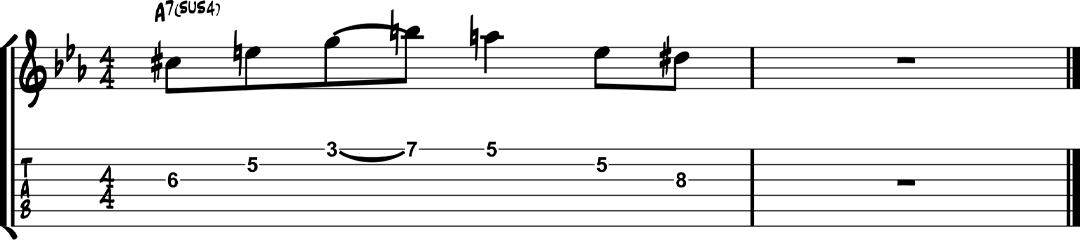
Lick 1 is a simple 3-9 arpeggio based on an A7 chord. However, I really like the style in which it’s played, particularly the legato slide from the G to the B. This is not a way that these arpeggios are typically played using standard “position playing” pedagogy of the guitar. Rhythmically, it’s very laid back behind the beat. The last note anticipates the next chord by landing on the seventh of the Ab7 chord.
Try modifying the last note to anticipate the harmony of the following measure in your own improvisations.
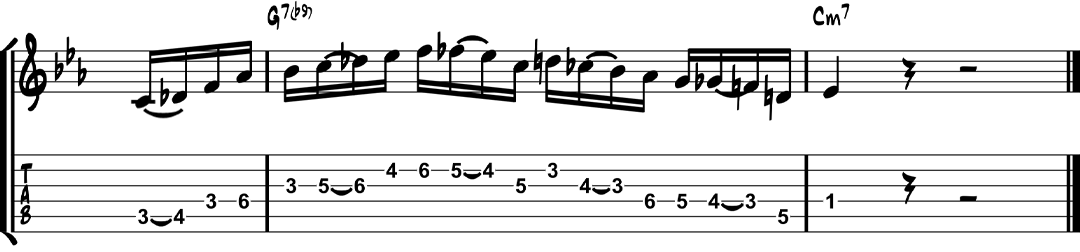
Lick 2 anticipates the G7 chord by bringing tension over the C-7 chord. It starts with a Db major 7 arpeggio on beat 4 that bleeds across the bar line into beat 1 of the next measure. This brings a Phrygian quality to the lick; a bit smoother sound than a pure tritone substitution. On beat 2 the lick hits the natural 5th of the G7, before traveling down the altered scale with some added chromaticism. The last two notes of the lick are an enclosure before resolving to an Eb on the downbeat, the third of the C- chord.
You could use this lick as ii-V in your solos by modifying the Db to a D natural to fit nicer into a standard ii-V structure or just leave it as is.
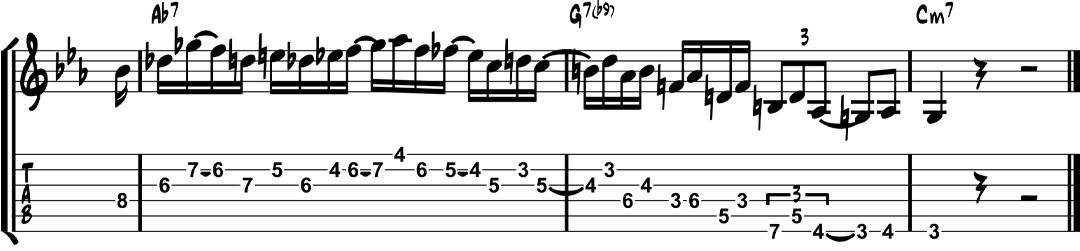
Lick 3 is a great turnaround lick. It starts off in the first measure with a Gb major triad, implying a suspended sound over the Ab7. Then we descend chromatically with some minor thirds; a common tactic employed by Metheny, before ripping through an Ab Lydian dominant scale. Over the G7 chord, he plays a sequenced B diminished arpeggio that resolves down to G, the fifth of the C-7 chord.
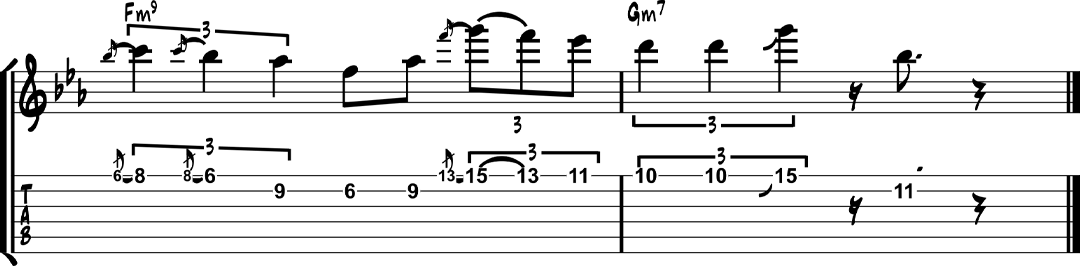
This last lick I like for stylistic reasons, similar to why I picked the first lick. Harmonically, Metheny plays F- pentatonic, leaps up to the ninth before descending scalarly to the fifth of the G-. Then he plays an inverted G- triad. However, what makes this lick stand out to me is the style with which it’s played. Metheny tends to break a lot of the rules when it comes to the guitar pedagogy of position playing. I love the inflections with which he plays the notes in the lick; the grace notes in the first measure and especially sliding into the high G in the second measure. The slight fade in volume due to not re-attacking the string for that note makes it very vocal in quality.
CONCLUSION
Amongst the monolithic jazz players on this tune, Pat Metheny earns his place as a true “guitar hero” even as a sideman. Not only does he employ a vast harmonic vocabulary and a highly advanced rhythmic concept, but the way he stylistically plays each note on the guitar demonstrates how he’s truly mastered the basics of this instrument in ways that others can only attempt to replicate.
As jazz musicians, we spend a lot of time learning how to expand our harmonic vocabulary with various scales, licks, chord voicings and more. But Metheny never forgets the simple things like inflection, repetition, and incorporates those things into the sophistication we spend so much time exploring, resulting in a voice that’s uniquely his. As you bring these ideas into the woodshed for your own practice, allow his approach to inform and inspire your own musical identity and help to bring simplicity to sophistication.
Written by Mike Hilbun