
What to Learn After Barre Chords

How to play triads on the guitar
Early on in your guitar journey, you were probably taught open position “cowboy” chords. These chords were great, but can be limiting at times. A couple steps down the line after that, chances are you learned barre chords which gave you access to chords you couldn’t play in open position. Most of those chords only have 3 different notes in them, even though you’re playing 5 or 6 strings (some of those notes get repeated). Today we’re going to eliminate some of the extra notes to smooth out our sound and open up the fretboard.
Most open position and barre chords are a special type of chord called triads (i.e. your standard major/minor chords). These triads are made up of only three different notes (hence the name) and because of that there are three different shapes, or inversions to learn. The different shapes/inversions come from changing the order of notes in the chord. This is what makes these more difficult to find on the guitar at first, because the root note is not always the lowest note like it is with barre chords, for instance. To make it easier, however, we will find these triads by playing smaller parts of larger open string/barre chords that you are already familiar with. Today, we will be working with major triads only.
Triad Shapes
Just as with barre chords we will have different shapes based on different string sets. I like to focus on the D, G, and B string set as well as the G, B, and e string set. You can do other string sets as well, but for our purposes today, we will stick with the D, G and B strings.
The first shape comes from a major barre chord with an E string root. Let’s use G as an example for this one. This inversion is fairly easy to spot because for this one, the root is the lowest note that you play. It’s still important to see this chord in the context of the larger shape (even if you aren’t playing the whole thing).
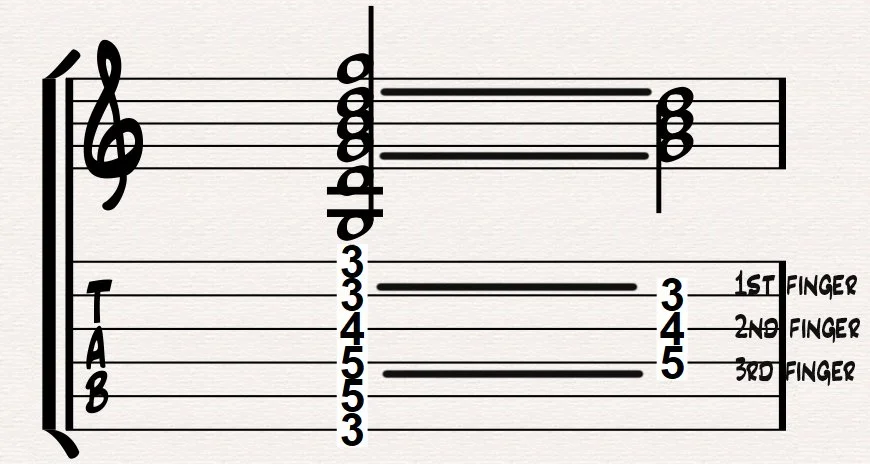
G major Root Position
The second shape comes from our C major shape. This one can be difficult to see, not only because the root is not our lowest note, but also because on our regular C chord, one of those notes is an open string. So for our example, I’ve moved the C up two frets to a D (so you can see the proper fingering). Because the root is not the lowest note in the chord, it’s absolutely important that you see this shape in it’s larger “C chord” context wherever you are on the fretboard. When I first started playing these, I only knew the names of the notes on the E and A strings so I would identify the root as being one fret higher than your 3rd finger, but on the A string.
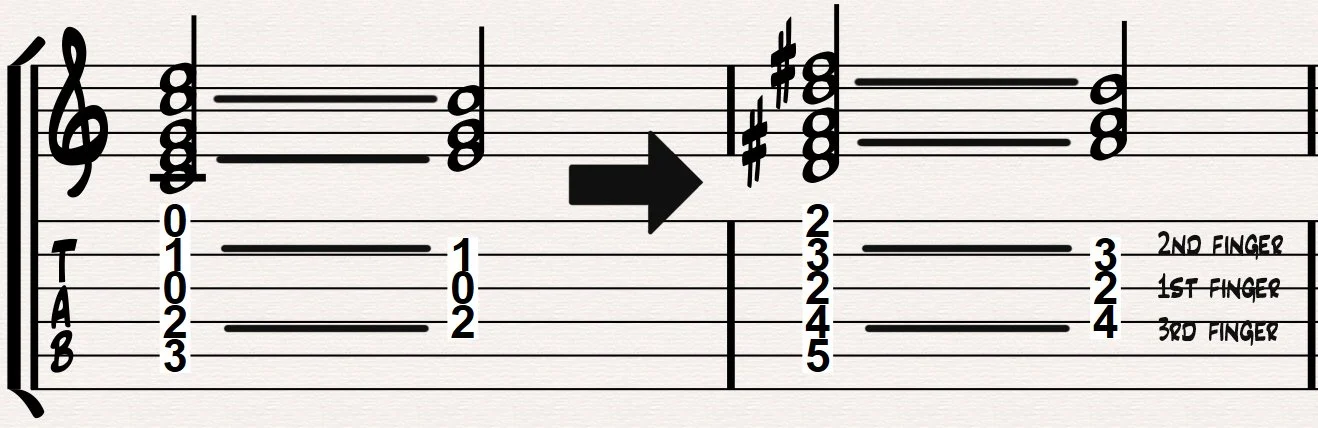
D major 1st inversion (derived from open C major shape)
The last shape I get from our open position A chord, or a barre chord with an A string root (however you want to look at it). I know there’s a lot of fingerings out there for an open position A major, however for this one I would strongly urge you to play this one as a barre with your first finger or (depending on the situation) with your third finger. Just as with our last shape, since the root isn’t the lowest note in the chord, make sure to see it in it’s larger context to identify the root note. I think of it as two frets back on the A string.
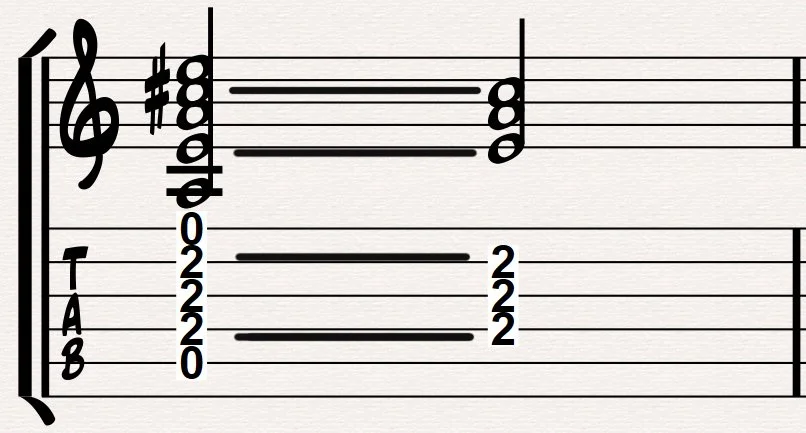
A major second inversion
There’s one last thing we need to do before we make music with this concept. I’ve shown you all three shapes found as smaller parts of chords you’re already familiar with. Now it’s time to show you all three inversions of one chord. Below are all the inversions of a G chord. Spend some time to relate all three shapes back to a root note/chord shape you are familiar with as we spoke about above.
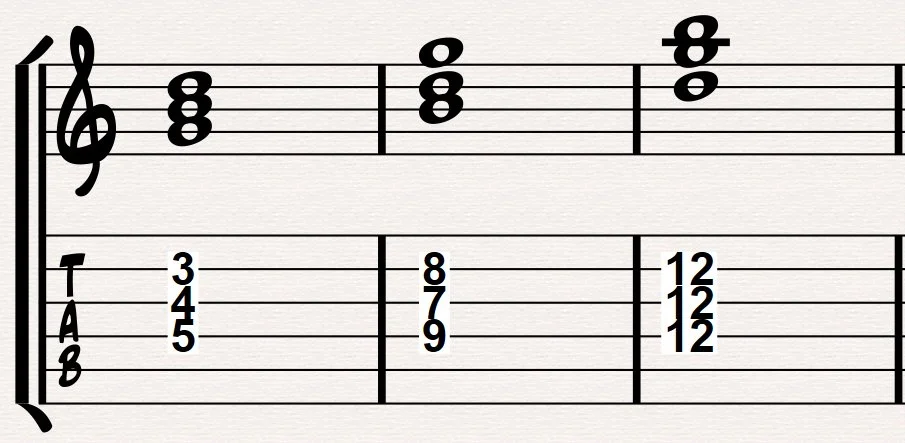
G major, all three inversions/shape
Try finding all the inversions of another chord such as C major, or A major now.
Mixing Different Chords Using Triad Shapes
The next thing to do is to apply this concept over a chord progression. Let’s look at an example playing these shapes over a slow and simple progression from “Wonderful Tonight” by Eric Clapton.

In this example, we’re using the triads in a somewhat “piano-y” way. This is a great way to come up with second guitar parts in a band so both of you aren’t just strumming the chords.
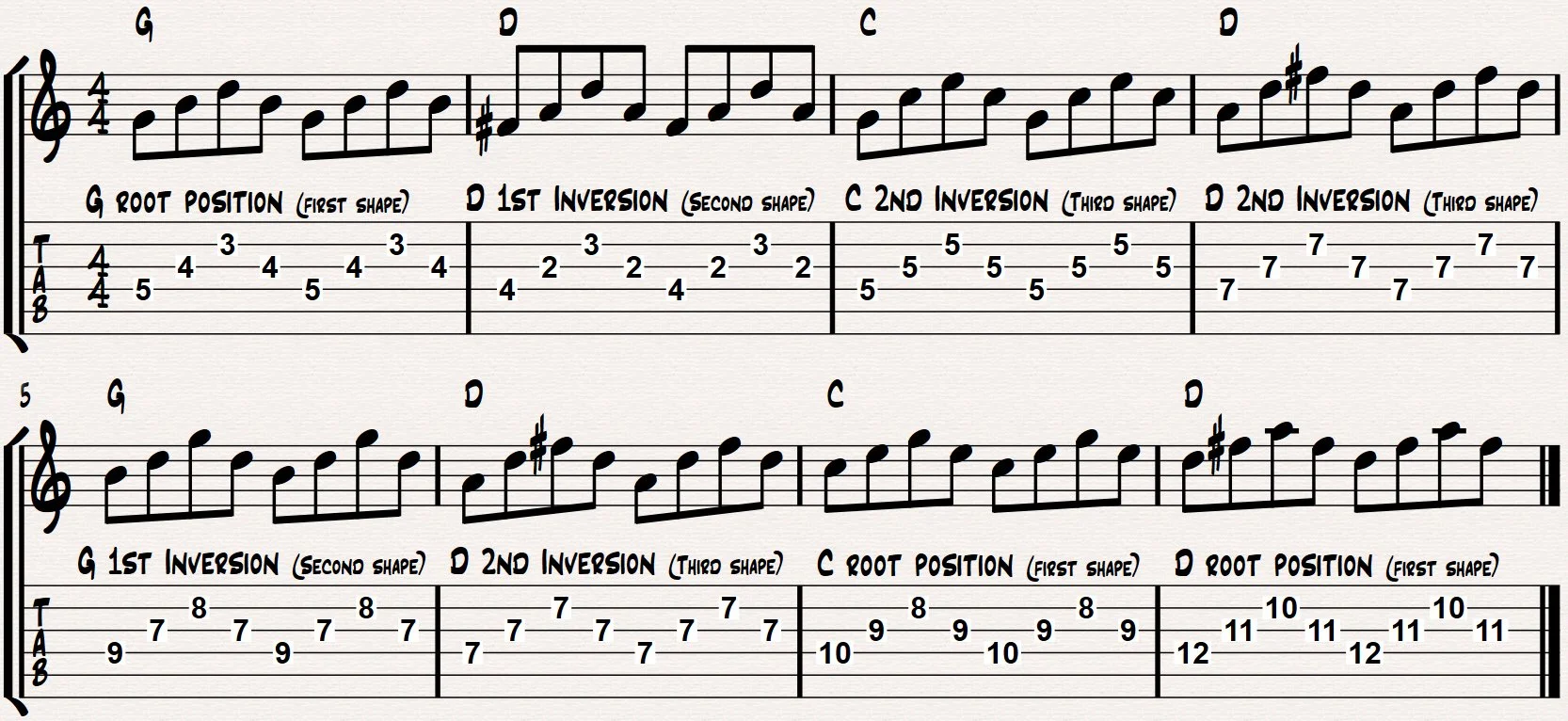
The great thing about playing with these triad shapes is the freedom it gives you. At first, you will want to stick to maybe one shape per chord just to get used to them, but eventually you’ll be able to move up and down the fretboard and really shape the overall sound of the song. Here’s another example that expands on the first progression by moving you from one area of the fretboard to another.
Conclusion
Triads are a logical next step after learning barre chords. This was just a start with triads. Even though we looked at major chords on the D, G, and B string set, you can certainly move these shapes to the G, B, and E string sets. And yes, we can convert these shapes to minor triads as well. The applications are endless. Even though we played these over a slow ballad, I use these shapes constantly when I play soul, funk, rock, jazz, Zydeco, and more. The more familiar you are with these shapes, the more possibilities are opened up.
Written by Mike Hilbun